Specifically, gonadectomies and the age at which they are performed have been linked to the incidence of many cancers, orthopedic conditions, other medical conditions, and behavioural issues. · spaying and neutering dogs and cats increases the risk of obesity.
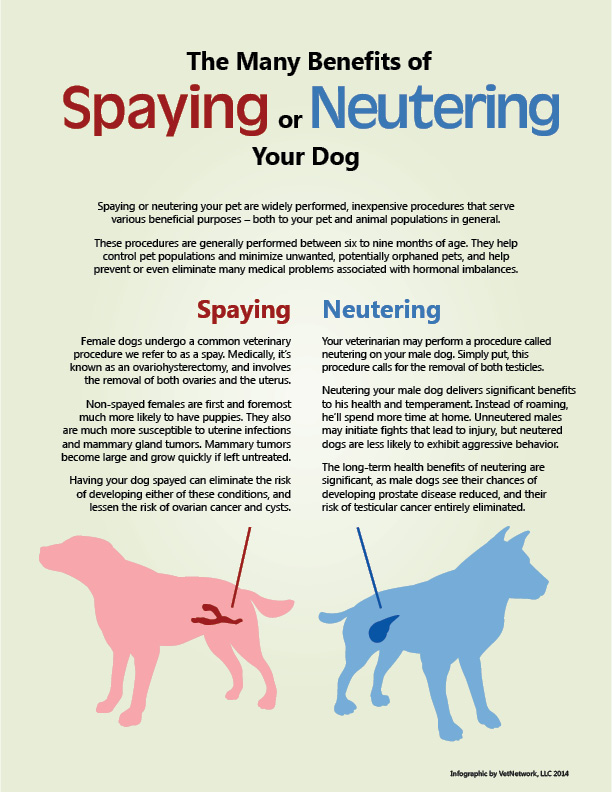
Veterinary Infographics Marketing Infographic for
Neutering can be performed on male dogs before or after the testes have dropped.

Spay vs neuter. Main difference between spay and neuter. Dog spay/neuter 90 and above $160 plus $1 per lb over The term is often used in reference to males.
The word ‘castration’is applied only to males and means removal of the testicles. Neutering generally refers to the castration of males. Over the last decade, it has become apparent that performing a gonadectomy (spaying or neutering) has unanticipated health implications.
The word ‘neutering’can be applied to male and female kittens or cats. Spaying a female dog can take 20 to 90 minutes, also depending on her. Spaying involves removing the uterus and ovaries of a female animal, and neutering removes the testicles of a male animal.
Spay involves the removal of the uterus and ovaries while neuter involves removal of testicles. Sterility and the absence of sexual activity. The term spaying is specifically used for females.
But practicing only the sterilization avoids the fertility of the dog. Spaying, (but not spading as it’s been called many times!) is only applied to female cats and involves the removal of the ovaries and commonly the uterus too. Each dog is different, which is why we prepared detailed guides on spaying and neutering that take those differences into account.
You will learn about neutering later in this guide, and you will see that spaying is much more painful than neutering. Spaying involves more complex, invasive surgery. Whether you are doing it for the greater good or for the good of your pet, spaying your female pet or neutering your male pet has many advantages.
The risk for sick dogs and cats were 1.33% and 1.40% respectively. Both terms refer to the surgical sterilization of an animal, but sometimes neuter is used for both genders. Neutering is fast and simple, the entire procedure taking just a few minutes.
Spay controls the birth of animals while neuter apart from controlling birth also increases the capacity of working. That is, the testicles in the case of males and the ovaries in females. “spays involve making entry into the abdominal cavity as well as.
What is the difference between spaying and neutering? The neuter surgery is simpler than a spay. The main difference between spay and neuter is that spay is a process in which the reproductive organs of female animals are removed and in neutering, males reproductive organs are removed.
To help with post operative pain, medications are given around the surgery time and afterward to ensure patient comfort. Still, when an animal is neutered, they require general anesthetic so they don’t feel any pain during surgery. Neutering is also called castration and is performed on male dogs.
In dogs, the effects of neutering as a risk factor for obesity vary between breeds. While the result, sterilization, is the same for both male and female pets, the procedure itself is quite a bit different. When a female dog is spayed, the vet removes her ovaries and usually her uterus as well.
Neutering can take anywhere from 5 to 20 minutes, all depending on your dog’s age, size, or any other medical issues present at the time of the surgery. Difference between spay and neuter. In this way, two things are achieved:
So, what is the difference between spay and neuter procedures? • therefore, the male specific advantages and disadvantages come with neutering while those for females come with spaying. Spaying or neutering will benefit your pet medically and behaviorally.
Neutering, from the latin neuter, is the removal of an animal's reproductive organs, part or whole. The female cat who has undergone spaying requires two to four weeks to recover and different activities restrictions. Spay and neuter are procedures of removing reproductive organs from the animal bodies.
When you first bring home your new pet, one of the best ways to give them a healthy start is to spay or neuter them. What is the difference between spay and neuter? In cats, a decrease in sex hormone levels seems to be associated with an increase in food intake.
Spaying is the removal of a female animal's reproductive organs, either all of it or a considerably large part. Explore alternative methods of spaying, find out at what age your dog should get one of these procedures and what are the pros and cons of each. Spaying refers to the sterilization of female animals.
Spaying, on one hand is the removal of reproductive organs of a female animal while neutering is exactly the same process for male animal. Spaying or ovariohysterectomy as per medical terminology, involves removal of. Spaying is equivalent to a hysterectomy in a human and is performed on female dogs or dogs with internal female anatomy.
In castration, the sex glands are removed by surgical techniques. Spaying is the removal of the female pet’s reproductive organs, while neutering refers to the procedure for male pets. Both of them are considered to be beneficial processes since it makes pets easier to live, happier, healthier.
However, only males are neutered while only females are spayed. The main difference between spay and neuter is that spay is a female animal whose reproductive system has been removed whereas neuter is either a male or a female animal whose reproductive system is been removed completely or to a large extent. Female and male pets, including cats and dogs, can be “fixed.”.
• both terms mean the removal of reproductive organs from an animal, but spaying is used for females while neutering is used for males. A spay is done in females while a neuter is done in males. The difference between spay and neuter comes down to the gender of the animal.
Soak a clean cloth or gauze in warm water or saline solution, or use a mild surgical scrub available from your veterinarian, and spot clean soiled areas. Take a clean cloth or baby wipes (free of any additives) and gently wipe the open incision area.

Is neuter incision infected?
For this reason, bathing is also prohibited for at least one week after surgery.

How to clean neuter incision. Top best answers to the question «should i clean my dogs neuter wound». It’s really important to keep that incision site as dry as possible to facilitate healing. You must not allow your dog or cat to get wet for at least 7 days after surgery.
If the incision looks dirty you can gently clean the area with a cotton ball and warm water. Do not use hydrogen peroxide. Secondly, how do i clean my dog's neuter incision?
If the incision looks dirty you can gently clean the area with a cotton ball and warm water. You must not allow your dog or cat to get wet for at least 7 days after surgery. A recent spay incision should be a clean, straight wound and the edges should be sealed with glue, stitches or staples.
🐶 how do i clean my dog's neuter incision? A waterpik or similar device produces a higher pressure stream of water that may be more effective in delivering water to clean an incision. Pat dry or clean around the incision, not directly on it, except when necessary by irrigating with saline.
Don’t bathe your pet or let them swim until their stitches or staples have been removed and your veterinarian has cleared you to do so. For this reason, bathing is also prohibited for at least one week after surgery. Do not use hydrogen peroxide.
If the incision looks dirty you can gently clean the area with a cotton ball and warm water. How do i clean my dog's neuter incision? Soak a clean cloth or gauze in warm water or saline solution, or use a mild surgical scrub available from your veterinarian, and spot clean soiled areas.
For this reason, bathing is also prohibited for at least one week after surgery. Never apply any cream, ointment, disinfectant, or other substance to the incision unless specifically instructed to do so by your veterinarian. However, when the incision area becomes dirty, use some cool soapy water to clean it and ensure that you part it dry to avoid further problems.
What color are dissolvable stitches? For a dog neuter, the veterinarian will make an incision over the penis just in front of the scrotum to clean a wound on a cat, start by soaking a cotton ball in a cleaning solution made from 1 cup of boiled water and ½ teaspoon of salt, and squeezing it so the liquid runs over the wound. Allowing the site to get wet and absorb water also leaves the area vulnerable to unwanted bacteria.
Generally speaking, swimming is a great exercise for dogs (or people!) with stiff and sore joints. Do not use hydrogen peroxide. When necessary to work in this area, wipe away from the incision area.
Use clean hands and clean materials when working on your recently neutered dog, to keep the surgical site clean and uncontaminated. You must not allow your dog or cat to get wet for at least 7 days after surgery. If the incision looks dirty you can gently clean the area with a cotton ball and warm water.
How do i clean my dog's neuter incision? The incision should normally be clean and the edges should be touching each other. First, wash your hands with an antibacterial soap.
Cleaning open dog neuter stitches involves keeping them dry. Soak a clean cloth or gauze in warm water or saline solution, or use a mild surgical scrub available from your veterinarian, and spot clean soiled areas. If the incision looks dirty you can gently clean the area with a cotton ball and warm water.
How to clean neuter incision dog? Do not bathe your dog or allow the incision to get wet. Watch for signs of infection of hemorrhage and get medical assistance if required.
For this reason, bathing is also prohibited for at least one week after surgery. Do not use hydrogen peroxide. While holding the dog in this position, check for any infection signs at the incision site check to see if it is swollen or it has turned red.
You must not allow your dog or cat to get wet for at least 7 days after surgery. Do not use hydrogen peroxide. As the incision heals, you will want to check the area for redness, swelling or discharge.
When necessary to work in this area, wipe away from the incision area. How do i clean my dog’s neuter incision? Avoid the incision area and abdomen.
Below is the procedure to check if a neuter incision is infected. How do you keep a neuter incision clean? Do not use hydrogen peroxide.
It is not unusual for the incision to become slightly redder during the first few days, as healing begins to take place. Avoid the incision area and abdomen. If the incision looks dirty you can gently clean the area with a cotton ball and warm water.
Do not use hydrogen peroxide. For this reason, bathing is also prohibited for at least one week after surgery. Turn the dog on its back if it is smaller, cradle her up.
With these, the infected neuter incision should get better and heal within no time. Else, keep the area as dry as possible. If the incision looks dirty you can gently clean the area with a cotton ball and warm water.
How do i clean my dog’s neuter incision? You must not allow your dog or cat to get wet for at least 7 days after surgery. In particular, never clean the incision with hydrogen peroxide or alcohol since these products will damage the cells and delay healing.
Avoid the incision area and abdomen. How do i clean my dog’s neuter incision?